
easyJet MPL stage 2 selection pre-trainingairline-selection
20 May 2026
Stage 2 is the ADAPT test, it’s made up of a series of tests which are all done online, including a personality questionnaire, non-calculator maths & physics, cognitive & numerical reasoning, and finally, a FAST test (which is around multi-tasking)
Since booking the stage 2 assessment I’ve been doing everything I can to prepare for it, given it’s been around 20 years since I’ve looked at some of the maths and physics that I would be tested on. I’ve had an app on my phone which gives a quick fire mental maths test which I’ve been doing in any downtime just to try and re-build that skill.
I also took the past week off work in order spend some dedicated, undistracted time, revising GCSE level topics in both maths and physics. In this post I’ll go over what I did to prepare and then go over in detail what happened during the actual test.
The company which runs these tests is called Symbiotics and they do provide some practice tests for each of these assessments. They are available individually or as a bundle, additionally candidates going through CAE are able to get a discount code which gives 10% off, you can find this online, so I won’t provide it here, as it may be different to the one I used.
The package I bought is the Cadet Essentials Bundle as it was the one that gives you everything except the personality test - but I don’t think that’s something you can easily change or practice for anyway! What is worth knowing though is that there will only be one version of each test, so if you go to do the maths test again for example, it’ll be the same set of questions again. So you can’t rely on this alone for your practice as you will eventually just learn the answers.
For the maths and physics, I went through each test once, to see how it was structured, and the areas I needed to spend more time revising, and then used AI to generate me a series of similar tests in the same format. Then the day before I re-took each of the tests as by then I’d completely forgotten the content and answers.
After taking the practice tests from Symbiotics, you get pretty comprehensive report, showing you your results, how long you spent on each question and then a summary of areas that you should revise before trying again.
By the end of that week of study, I was getting a comfortable pass in every test, so I did go into the real thing feeling reasonably confident that I’d do ok.
The actual test
I’d booked my slot for the afternoon as I find that’s when my mind is most alert and awake when I’m at work. About 5 days before the assessment I was sent a link to the personality questionnaire. You were asked to register on the Symbiotics site, and then enter the code that was given in the e-mail. As I already had an account from buying the practice test, I just had to enter the code and a new line came up on my dashboard, which was CAE Gatwick: easyJet MPL (remote), with a start button next to it.
On clicking that, it opened up a test, in the same layout as the ones I’d been practising. The questions were broken into sections, and for most of them you were choosing on a scale of 1-5, strongly agree/strongly disagree etc, some were only on a scale of 1-4 so you could not go for the middle option. There is no time limit, but it’s suggested that you do it in one sitting, and answer as quickly and truthfully as you can. There are over 100 questions to answer and a number of them are repeated but re-phrased, presumably this is to catch out people who are answering what they think the airline wants to hear rather than their true reaction. Once complete you’re returned to the dashboard.
On the actual day, I logged into the Symbiotics website again, and clicked start on that CAE line. It asked my to share my screen, and then a few moments later I noticed my webcam light came on, and a message appeared on the screen to say that the proctor (remote invigilator) could now see and hear me. I was expecting to hear from them and possibly have a visual check done of the room, to ensure I wasn’t cheating, however nothing else happened, other that the suite of tests now also appeared on screen, with buttons to start each one individually.
It wasn’t totally clear if I should just start, so clicked the assist button, which prompted the proctor to check in, and I was able to ask If I should. The response was yes, and that was the last I heard from them.
It seemed you could choose to do them in any order, I just opted to go top to bottom, so I began with:
Maths test
This was 30 minutes, 20 questions, and you have a countdown timer in the bottom left of the screen. You are also able to flag questions to come back to, and you can do them in any order.
I knew from some research prior, and the practice tests that questions 16-20 were worth 5 marks, 6-15 were worth 2 marks, and the first 5 only 1 mark, so I worked bottom to top, knowing I could spend half of the test on those last 4, to get nearly half the marks, and it’d get progressively easier as I went through.
Due to some nerves, my mind blanked a little initially as question 20 was slightly harder than the practice questions I’d been doing, but eventually I got into the swing of it, and I calculated answers for every question which matched one of the 4 multiple choice answers.
I did flag one to come back to as it had asked for an approximate value, and my answer was close to one of the options but not exact, so I came back to it at the end, however I ran out of time to finish re-calculating it and the test automatically ended - I had put an answer for every question though.
The questions were not particularly hard, topics included:
- Speed/distance/time calculations, involving fractions of hours which did not always align neatly to 15, 6, or 20 minute intervals (if you know, you know…)
- Pythagoras, so knowing your squares up to 25 is useful, (the first waypoint is 6nm south of airfield A, and airfield B is then 8 miles East what would the straight line distance be?)
- Fuel burn calculations, which included calculating speed/distance/time first, multiplying by a fuel burn/hour figure, and then dividing/multiplying to get it in Kg.
- Number of questions around bearings/headings, e.g. start at 40 degrees, turn left 110, then right 30 what heading do you end up on.
After that was complete, took a minute or so to pause and have drink before diving into the physics test.
Physics test
Very similar format and marking structure to the maths, so again I worked bottom to top - topics there were:
- Working our spring extensions in series and parallel
- Calculating pressure when the temperature changes (watch out for it saying ‘increases by’ as you have to add that to the original temperature - one of the answer options was what you’d get if you’d just calculated it on that given increase value)
- Calculating resistance in a circuit, with resistors in parallel and series
- Calculating forces on a balance beam
- Basic knowledge (X is the unit of measure for what? Which of the following cannot travel through a vacuum? etc)
Cognitive reasoning
Next up was the cognitive reasoning. Again 30 minutes for this test, but many more questions.
It starts off with around 5 maths questions, similar to the earlier tests, mainly speed distance time, or simple mental maths.
Next is verbal reasoning, with questions like “select the word that is opposite to regular”.
Then it is onto spatial relationship reasoning, this is where you have to do things like selecting the shape which is a mirror image of the one given, or, given the flattened net of a cube with different colours/patterns on each face, choose the option which it could be when folded up.
Next is abstract reasoning, where you have questions like picking the shape which does not fit in with others on the screen (there’ll be a pattern to this, normally rotation or size, and one of them won’t follow it), or being shown a grid with one empty square, and asked what would go there (again there’ll be a pattern)
The next section is on perceptual speed and accuracy - for this section your responses are timed, and although you can go back to view the answer you gave, you are not able to change it. You have to answer these both quickly and accurately. It’ll be things like, which of the 4 options are the same as this number sequence, and all the other answers are very subtle variations (like an I instead of a 1, or letter capitalised etc)
Then it’s onto working memory, for this section, you’re either shown an image, which disappears after a few seconds, or listen to some audio and then have to answer a question based on it. e.g. a radar screen with two contacts and a direction indication, then pick which image shows where they would meet, or a sequence of letters and numbers read aloud, then pick the option which matches.
It sounds like a lot, but there are only a few questions in each of those sections so you get through them quickly - I had time at the end to go back and review the numerical reasoning answers and even just rerun my calculations to check the answers, and still finished with 10 mins to spare. I did find this test easy in the practice ones too though.
The final test was by far the hardest and the one I think everyone dreads.
FAST test
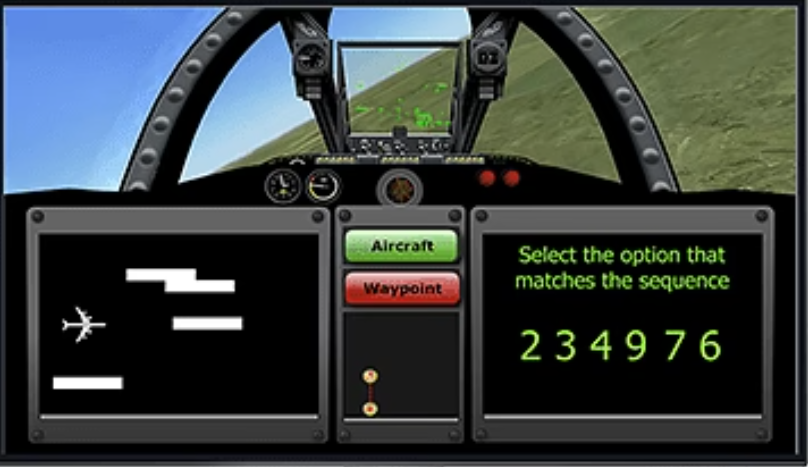
If you’ve never heard of it before, you are essentially looking at the above image for 3 minutes straight, the aircraft is flying a course automatically with an ATC voice giving information about the route you are flying, including altitudes, headings, names of the waypoints.
You have to click the waypoint button whenever the aircraft turns, and click the aircraft button whenever you see another aircraft flying past.
The little game in the bottom left, you are controlling the aircraft with the up and down arrow keys, trying to avoid the blocks as they move right to left across the screen.
In the bottom right you are given a range of numerical and cognitive reasoning tests, some like the screenshot in text format, others given verbally, at random intervals, and you only have a couple of seconds to answer.
While doing all of that some other things will happen too, the red lights in the cockpit may or may not blink, and you may or may not hear some beeps.
After the 3 minutes, you are given a timed test, where you have to answer quickly, asking questions about what you just did. Examples include:
- How many times did the red light flash
- How many different aircraft were there
- What was the first waypoint
- How many different voices were there
- What was the layout of the cockpit (then presented with 4 very similar images, with the gauges in different places)
You then run through the exact same 3 minutes, with everything happening exactly as before, same questions, same route etc - the idea being that you now know what questions are coming afterwards, and should remember some of the answers you gave during the test last time, which should free up some mental capacity, so there should be an improvement in all areas of the test.
You get the same set of questions at the end again, and hopefully this time you’ll know the answers to most rather than guessing!
I felt like I did ok in this one, slightly improving in the second run, but I certainly felt like I did better in the practice test.
Once it was complete, I was returned to the dashboard page, & I noted that the message saying I was being watched was gone, and the light on my webcam was also now, off - so that was it test over! Slightly surprised there was nothing at all from the proctor at the end of the test, but then again I imagine they’re running through quite a few of these at the moment!
Overall I was maybe about 60-70% when I finished that I’d done enough to pass it, I was less sure about the FAST test, given the improvement didn’t feel as clear-cut to me as it had in practice, but there was nothing more I could do now other than wait and hope I’d done enough.
Results
Luckily I didn’t have to wait too long as the following morning at around 11am, I had an e-mail in my inbox telling me I’d been successful and was through to stage 3! Which is the final stage to get a place, and a job offer with easyJet - it’s the interview and group exercise.
Safe to say I was very happy to get that e-mail, as the part of the assessment I was most worried about is now done!